Are we seeing the beginning of a Newgarden/Rossi rivalry?

The NTT IndyCar Series is now past the halfway point with nine of the 17 races completed. While there have been ups and down for every driver so far this year, a brewing “rivalry” between the top two drivers in the standings may be a sign of things to come for the future of the sport.

Josef Newgarden and Alexander Rossi are both young American drivers in their late 20’s. They both have their own podcast. They have combined to win the two biggest prizes in the series, with Rossi taking the Indy 500 in 2016 and Newgarden the series championship in 2017. And boy are they both fast.

Newgarden recently held off Rossi for the final 13 laps of an electrifying race at Texas Speedway to grab his third win of the season and maintain a 25-point lead over Rossi in the championship standings heading into Road America this weekend.

Newgarden began the day in seventh and was passed by Rossi and Colton Herta early in the race to settle in around the back end of the top-10 for most of the day. A crash from Zach Veach on lap 135 opened the door for Newgarden to only lose one position by going off the leader’s pit strategy and opting for new tires and fuel to go longer during the middle stint of the race.

The strategy ultimately paid off when he was able to put in much quicker laps than the leaders as they approached 50 laps to go and he came out of the pits with the lead on lap 203 of 248. A big defense on Scott Dixon during a restart allowed him to stay in first, followed by a tense final stretch where he had to defend on Rossi every corner to come away with his first win on a super speedway. However, it was Rossi who made headlines for his one-handed save of his car after narrowly avoiding a crash between Dixon and Herta.

The race at Texas highlighted the game of inches that can determine who will raise the Astor Cup at the end of the season. The margin is extremely fine between these two, and they’ve proven to be the two to beat in the battle between Penske and Andretti this year.

The battle between the two has swung back and forth all year. Newgarden started the year off with the championship lead after some speed and solid pit strategy gave him a victory at St. Petersburg. He also got the best of Rossi at Barber Motorsports Park after starting 16th and aggressively sliding past Rossi at the hairpin in the final laps to finish fourth. Rossi bounced back by leading 80 of 85 laps at Long Beach and besting Newgarden by over 20 seconds.

Rossi has finished in second place three of the last four races, but two of those efforts have come as the runner-up to Newgarden himself. Newgarden benefited from a great strategy call at Belle Isle Race 1 to enter the pits early for slick tires in wet conditions, and a caution meant he inherited the lead. He once again had to hold off Rossi on the restart and throughout the closing laps even though Rossi had a faster car, very similar to the last race at Texas.

Newgarden took his first pole of the season in Belle Isle Race 2 with Rossi lined up next to him on the front row, but “saucy” Rossi got the best of Newgarden in the race. They both came out of the pits hot on the tail of James Hinchcliffe in the middle of the race, and Rossi began to make a move on Newgarden. Newgarden lost control of his car and took Hinchcliffe into the wall. Rossi miraculously managed to avoid any contact and saved the car by bringing it home in fifth place to significantly narrow the gap to Newgarden at the top of the standings.

The driving styles between the two also creates an exciting dynamic. While Newgarden is the bigger personality and loves the spotlight, he is more reserved in the car and tends to bide his time before striking through definitive moves or great strategy from the #2 team and race strategist Tim Cindric. Rossi is the much more reserved personality, but once he gets in the car he will use the limit of any track to attempt passes and is one of the more aggressive drivers in the whole series. Newgarden has shown some of those tendencies in big moments like on Will Power at Mid Ohio and Simon Pagenaud at Gateway in 2017, and also against Dixon in Texas this year. However, the varied style between these two makes their battle even more exciting.

Newgarden recently said on the Marshall Pruett Podcast that he doesn’t really see it as a rivalry because it implies some dislike between the two, and he feels Rossi always races him fair. Despite his kind words, any battle between two up-and-coming American drivers is going to be a battle that people want to see for years to come.

Newgarden had never won at the tracks where he claimed his first three victories this year before 2019. The rest of the schedule looks more promising for him as he won at Road America last year, Toronto, Mid Ohio and Gateway in 2017 and Iowa in 2016. Rossi will be the defending champ at Mid Ohio and Pocono in the later stages of the season.

Both will lineup within the top-four on Sunday at Road America, with Rossi in second and Newgarden right behind him in fourth. If the first half of the season has taught us anything, it’s that there will be many more opportunities for these drivers to prove who’s superior in the season’s final stretch.

Other Mid-Season Thoughts

  • Colton Herta has proven he’s quick, but some of his decisions and luck have shown how tough it can be to race as a teenager in IndyCar. He became the youngest race winner in series history at COTA in March, but it’s been almost all downhill since his historic feat. A crash at Long Beach, engine problems in the opening laps at the Indy 500 and crashing out Dixon from third place at Texas has dropped him all the way down to 16th in the standings. He took the pole yesterday at Road America to also become the youngest pole sitter of all-time. Let’s see if he can make that count and return to the top of the field.
  • I expected Santino Ferrucci to have a disappointing first year in IndyCar after a difficult past in Formula 2 racing. The young American has surprised basically everyone with five top-10 finishes so far and a career-best fourth at Texas two weeks ago. The Dale Coyne driver currently leads the Rookie of the Year standings by 12 points over the much-heralded Ganassi driver Felix Rosenqvist. He also has done an immense job to lead his teammate Sebastien Bourdais by three points entering Road America.
  • It’s been fun seeing Marcus Ericsson finally put together some standout performances the past two races at Belle Isle and Texas. He finished on his first podium since 2013 in Formula 2 after a shaky Formula 1 stretch, and he led laps in the past two races for the first time in his IndyCar career. A seventh place finish at Texas in only his second oval race proves he may finally be feeling comfortable in America.
  • Will Power has only finished on two podiums this year and has yet to win a race in 2019. Power has won at least once race in every year he’s competed in IndyCar, which stretches back to 2008. He’ll win at least one of the remaining eight races, and that could begin today as he lines up third at Road America.
  • Takuma Sato may be 42 years old, but he’s proving to be more competitive than ever with RLL Racing. A win at Alabama and podiums at Indy and Belle Isle has him firmly placed in the top-five in the championship standings. He’s never finished a season higher than eighth.
  • Scott Dixon may have run out of luck this year after an unbelievable run of form for his fifth championship last year. Crashes, mechanical problems and occasional lack of pace have fallen on the #9 car as he already trails Newgarden by almost 100 points in the standings. Dixon will have to go on a multi-win tear down the stretch if he wants to win his sixth championship.

Career Stats for 2019 Drivers

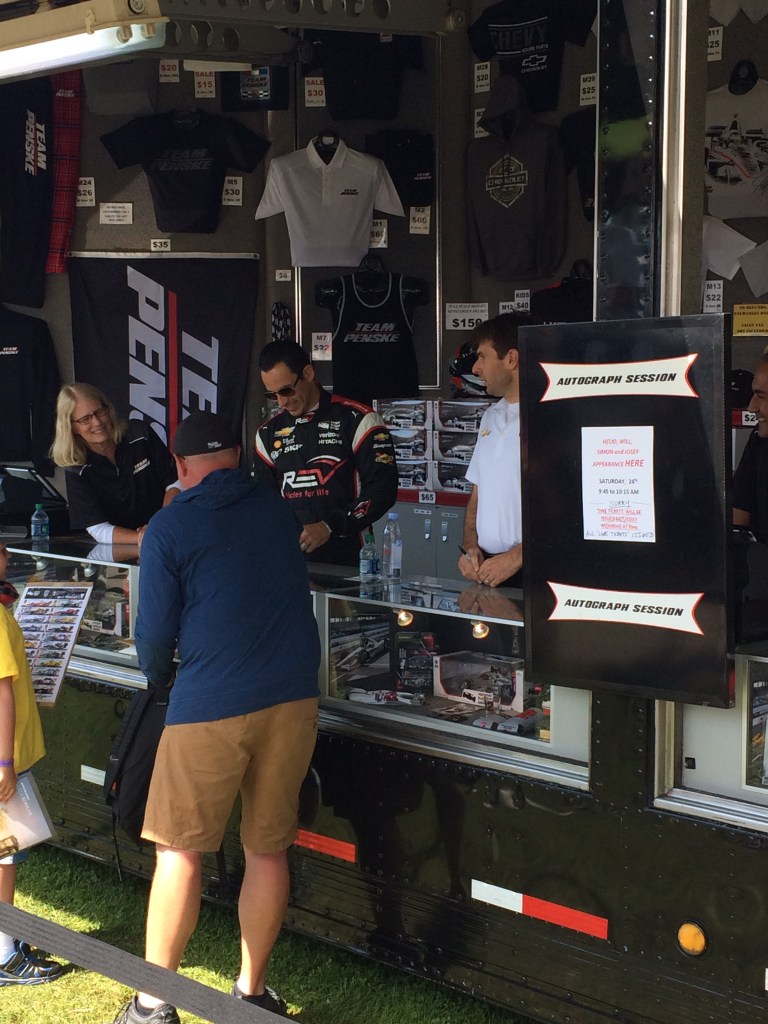
Josef Newgarden and Simon Pagenaud sign autographs at Road America in 2017.

Rookies with no stats: Marcus Ericsson, Felix Rosenqvist, Ben Hanley

Total Starts

  1. Tony Kanaan: 360
  2. Scott Dixon: 304
  3. Ryan Hunter-Reay: 235
  4. Marco Andretti: 217
  5. Will Power: 204
  6. Graham Rahal: 194
  7. Sebastien Bourdais: 188
  8. Ed Carpenter: 176
  9. Takuma Sato: 152
  10. Simon Pagenaud: 135
  11. Charlie Kimball: 134
  12. James Hinchcliffe: 122
  13. Josef Newgarden: 117
  14. Alexander Rossi: 50
  15. Max Chilton: 50
  16. Spencer Pigot: 39
  17. Ed Jones: 34
  18. Zach Veach: 19
  19. Matheus Leist: 17
  20. Jack Harvey: 9
  21. Santino Ferrucci: 4
  22. Kyle Kaiser: 4
  23. Colton Herta: 1
  24. Pato O’Ward: 1

Wins

  1. Scott Dixon: 44
  2. Sebastien Bourdais: 37
  3. Will Power: 35
  4. Ryan Hunter-Reay: 18
  5. Tony Kanaan: 17
  6. Simon Pagenaud: 11
  7. Josef Newgarden: 10
  8. James Hinchcliffe: 6
  9. Graham Rahal: 6
  10. Alexander Rossi: 5
  11. Ed Carpenter: 3
  12. Takuma Sato: 3
  13. Marco Andretti: 2
  14. Charlie Kimball: 1

Poles

  1. Will Power: 54
  2. Sebastien Bourdais: 34
  3. Scott Dixon: 26
  4. Tony Kanaan: 15
  5. Simon Pagenaud: 10
  6. Ryan Hunter-Reay: 7
  7. Takuma Sato: 7
  8. Josef Newgarden: 6
  9. Marco Andretti: 5
  10. Alexander Rossi: 4
  11. Ed Carpenter: 4
  12. Graham Rahal: 3
  13. James Hinchcliffe: 1
  14. Charlie Kimball: 1

Podiums

  1. Scott Dixon: 106
  2. Tony Kanaan: 77
  3. Will Power: 70
  4. Sebastien Bourdais: 56
  5. Ryan Hunter-Reay: 42
  6. Simon Pagenaud: 28
  7. Graham Rahal: 23
  8. Josef Newgarden: 22
  9. Marco Andretti: 20
  10. James Hinchcliffe: 15
  11. Alexander Rossi: 12
  12. Takuma Sato: 8
  13. Ed Carpenter: 7
  14. Charlie Kimball: 6
  15. Ed Jones: 3
  16. Spencer Pigot: 1

Top-10 Finishes

  1. Tony Kanaan: 220
  2. Scott Dixon: 219
  3. Will Power: 132
  4. Ryan Hunter-Reay: 117
  5. Sebastien Bourdais: 111
  6. Marco Andretti: 101
  7. Simon Pagenaud: 95
  8. Graham Rahal: 95
  9. Josef Newgarden: 61
  10. James Hinchcliffe: 61
  11. Charlie Kimball: 55
  12. Ed Carpenter: 48
  13. Takuma Sato: 47
  14. Alexander Rossi: 30
  15. Ed Jones: 13
  16. Spencer Pigot: 10
  17. Max Chilton: 8
  18. Zach Veach: 5
  19. Pato O’Ward: 1

Driver and Team Stats: 2018

Will Power and Helio Castroneves sign autographs at Road America in 2017.

As the season opener at St. Petersburg approaches, Push2Pass went through the 2018 statistics to go through every team and drivers’ average qualifying and finishing positions last season. These statistics were utilized throughout the team previews, but are compiled here for easier comparison and ranking.

Note: Team statistics do not include one-off entries at the Indy 500. Individual statistics include drivers who participated in at least two races in a full-time car.

Individual Stats

Average Qualifying

  1. Will Power: 2.8
  2. Josef Newgarden: 5.2
  3. Alexander Rossi: 6.3
  4. Ryan Hunter-Reay: 6.3
  5. Robert Wickens: 6.4
  6. Scott Dixon: 7.6
  7. Simon Pagenaud: 8.0
  8. Sebastien Bourdais: 9.8
  9. James Hinchcliffe: 11.0
  10. Ed Carpenter: 11.3
  11. Takuma Sato: 12.2
  12. Marco Andretti: 12.4
  13. Ed Jones: 13.1
  14. Jordan King: 13.1
  15. Graham Rahal: 13.2
  16. Zach Veach: 14.5
  17. Spencer Pigot: 14.8
  18. Tony Kanaan: 14.9
  19. Conor Daly: 15.7
  20. Pietro Fittipaldi: 16.5
  21. Santino Ferrucci: 17.3
  22. Max Chilton: 17.5
  23. Matheus Leist: 17.6
  24. Carlos Munoz 18.0
  25. Gabby Chaves: 18.4
  26. Zachary Claman DeMelo: 19.1
  27. Jack Harvey: 19.3
  28. Charlie Kimball: 19.4
  29. Kyle Kaiser: 19.8
  30. Alfonso Celis Jr: 22.0
  31. Rene Binder: 22.2

Average Finish (Championship Standings)

  1. Scott Dixon: 4.2 (1st)
  2. Alexander Rossi: 5.7 (2nd)
  3. Josef Newgarden: 7.1 (5th)
  4. Simon Pagenaud: 8.6 (6th)
  5. Ryan Hunter-Reay: 8.7 (4th)
  6. Robert Wickens: 8.9 (11th)
  7. Will Power: 9.5 (3rd)
  8. James Hinchcliffe: 10.1 (10th)
  9. Ed Carpenter: 10.2 (20th)
  10. Sebastien Bourdais: 11.1 (7th)
  11. Graham Rahal: 11.1 (8th)
  12. Marco Andretti: 11.1 (9th)
  13. Takuma Sato: 13.2 (12th)
  14. Ed Jones: 13.2 (13th)
  15. Spencer Pigot: 13.6 (14th)
  16. Tony Kanaan: 13.8 (16th)
  17. Zach Veach: 14.1 (15th)
  18. Charlie Kimball: 15.0 (17th)
  19. Carlos Munoz 15.0 (25th)
  20. Jordan King: 15.8 (22nd)
  21. Conor Daly: 16.7 (29th)
  22. Matheus Leist: 16.8 (18th)
  23. Gabby Chaves: 17.1 (21st)
  24. Jack Harvey: 17.3 (24th)
  25. Pietro Fittipaldi: 17.3 (26th)
  26. Zachary Claman DeMelo: 17.8 (23rd)
  27. Max Chilton: 17.9 (19th)
  28. Santino Ferrucci: 18.3 (27th)
  29. Alfonso Celis Jr: 18.5 (36th)
  30. Rene Binder: 19.8 (28th)
  31. Kyle Kaiser: 21.3 (30th)

Team Stats

Average Qualifying

  1. Penske: 5.3
  2. Schmidt Peterson: 9.5
  3. Andretti: 9.9
  4. Ganassi: 10.4
  5. RLL: 12.7
  6. ECR: 13.7
  7. Dale Coyne: 14.1
  8. A.J. Foyt: 16.3
  9. Harding: 17.2
  10. Carlin: 18.4
  11. Meyer Shank w/Schmidt Peterson 19.3
  12. Juncos: 21.3

Average Finish

  1. Penske: 8.4
  2. Ganassi: 8.7
  3. Schmidt Peterson 9.6
  4. Andretti: 9.9
  5. RLL: 12.2
  6. ECR: 13.7
  7. Dale Coyne: 14.6
  8. A.J. Foyt: 15.3
  9. Carlin: 16.5
  10. Harding: 16.6
  11. Meyer Shank w/Schmidt Peterson 17.3
  12. Juncos: 20.1

Driver Heights: Does It Matter?

Graham Rahal drives around turn seven at Road America. Rahal is the tallest current IndyCar driver at 6’2.

Does your height make a difference in IndyCar racing? After searching the web for the heights of every IndyCar driver for 2019, some of the stats are surprising.

  • Zach Veach: 5’2
  • Takuma Sato: 5’4
  • Tony Kanaan: 5’5
  • Santino Ferucci: 5’5
  • Felix Rosenqvist: 5’7
  • Marco Andretti: 5’8
  • Ed Jones: 5’8
  • Matheus Leist: 5’9
  • James Hinchcliffe: 5’9
  • Spencer Pigot: 5’9
  • Ed Carpenter: 5’9
  • Jack Harvey: 5’9
  • Pato O’Ward: 5’9
  • Colton Herta: 5’10
  • Ben Hanley: 5’10
  • Charlie Kimball: 5’10
  • Scott Dixon: 5’10
  • Will Power: 5’10
  • Sebastien Bourdais: 5’10
  • Simon Pagenaud: 5’10
  • Marcus Ericsson: 5’11
  • Max Chilton: 6’0
  • Josef Newgarden: 6’0
  • Alexander Rossi: 6’1
  • Ryan Hunter-Reay: 6’1
  • Graham Rahal 6’2

Breaking down the data shows that only five drivers are 6’0 or taller, with Graham Rahal being the leader at 6’2. The tallest IndyCar driver in recent years was Justin Wilson at over 6’3, who died in 2015 after being hit in the head by a nose cone at Pocono. There were only four drivers 5’5 or shorter. Zach Veach was easily the shortest driver at 5’2.

The average height for the IndyCar grid is about 5’9, and six drivers register at that height. The most common height was at 5’10 with seven drivers, and half of the field is listed at either 5’9 or 5’10. This follows very closely with the average height for American men. The Centers for Disease Control and Prevention said in 2016 that the average height for men is 5’9 in the U.S.

The tallest drivers in Formula 1 are usually just at 6’0, and Estaban Ocon was the tallest in recent years at 6’1. This list of IndyCar heights shows that drivers above 6’0 can still compete for championships, like Hunter-Reay’s title in 2012 and Rossi’s runner-up finish last season. However, the most important factor is weight and body build.

Rahal weighs closer to 200 pounds, and he described his biceps as “bigger than Rossi’s legs” on the Marshall Pruett podcast earlier this month. He added that he faces challenges like having his steering wheel as high as possible on ovals, which means more debris hitting his hands during the race. He also had to step away from the Acura Penske team in endurance racing because he couldn’t ever feel comfortable in the smaller prototype.

Rossi weighs under 160 pounds, and Hunter-Reay is listed at 175 pounds. Newgarden is the second-heaviest at 177 pounds, which leaves a huge gap to Rahal. Rahal has still had lots of success in IndyCar, winning six races and appearing on 23 podiums in 194 starts.

Teams are required to meet a minimum weight, so teams with lighter drivers use ballast to achieve the correct weight by adding it with tungsten parts under the seat or up to 10 pounds by the pedals. Drivers heavier than the 185 pound target, which is only Rahal, can use strategies like titanium bolts to lighten the car to meet the 185 pound target. This is a costly process, but it ensures that everyone is as equal as possible in the spec-series of IndyCar.

Being a tall driver can have its difficulties, but it’s less important than in Formula 1. There aren’t requirements to have weights of drivers balanced out in F1, which can hinder larger drivers and force them to make sacrifices. One example is Marcus Ericsson, who said last year that he hasn’t had a drink system in his car for two years in order to save weight.

Taller drivers generally have larger builds and carry more weight, making it difficult to fit inside the cockpit of the car. It seems that being taller than 6’3 and weighing more than 200 pounds is currently the cut off point for being able to effectively fit inside an IndyCar.