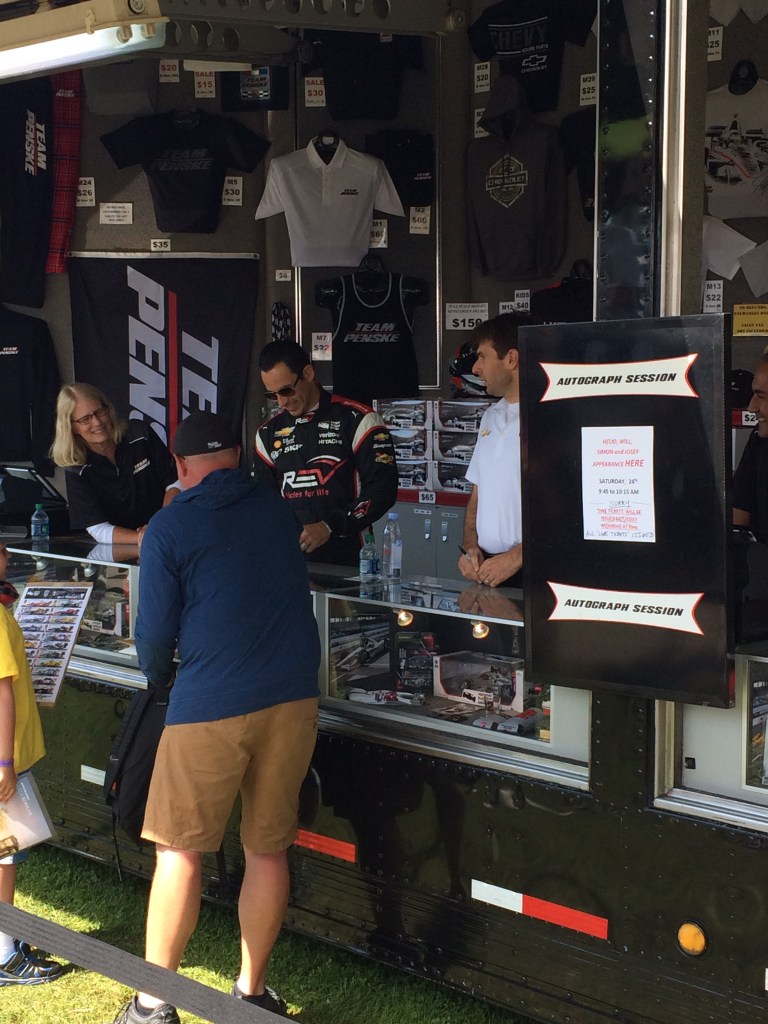
Will Power and Helio Castroneves sign autographs at Road America in 2017.
As the season opener at St. Petersburg approaches, Push2Pass went through the 2018 statistics to go through every team and drivers’ average qualifying and finishing positions last season. These statistics were utilized throughout the team previews, but are compiled here for easier comparison and ranking.
Note: Team statistics do not include one-off entries at the Indy 500. Individual statistics include drivers who participated in at least two races in a full-time car.
This is the final part in a 12-part series previewing every team set to compete in the 2019 IndyCar season. This concludes our preview of two teams per week on Push2Pass leading up to the season opener in St. Petersburg on March 10. Today’s team: Andretti Autosport
With one of the most successful drivers in American racing as its namesake, Andretti Autosport has been one of the most-decorated IndyCar teams of all-time. They have 62 wins to their credit since entering CART in 1994, and they made the switch to IndyCar in 2003. This is the fourth-most wins by a team in history, only trailing Penske, Newman/Haas and Chip Ganassi Racing.
While Mario Andretti raced at the Indy 500 for almost 30 years and won races in Formula 1, IndyCar, Nascar and in sports cars, he never actually raced for Andretti. His son Michael was the first Andretti to race for the team in 2001, winning a race at Toronto that season. Michael is now the team owner and previously won a series championship as a driver in 1991. He also holds the infamous record of leading the most laps over a career at the Indy 500 without winning the race (431). Ever since Mario won the Indy 500 in 1969, an Andretti has entered the race 54 times without a win.
Jacques Villeneuve won the Indy 500 and series championship in the team’s second season in 1995, and Dan Wheldon completed the double as well in 2005. The team has five series championships and five Indy 500 wins to its credit.
Rossi took a major step forward in 2018 by grabbing three wins and three poles in an effort that saw him finish runner-up to champion Scott Dixon. “Saucy” Rossi (nickname given by friend and fellow-IndyCar driver Conor Daly) proved that he was ready to become a contender when he bumped Robert Wickens out of the way on the final lap of the season opener in a desperate attempt to take the lead at St. Petersburg. He still managed to bring the car home in third despite the contact, following it up with a third place finish at Phoenix and a dominant win from pole at Long Beach.
Rossi had serious difficulty in the weeks leading up to the Indy 500 when he only qualified in 32nd place on the last row of the grid. He managed to put in an impressive drive by finishing in fourth place, passing as many as seven cars in one move. He also dared to pass and drive along the wall in a way that none of the other drivers felt comfortable with in the new aero kit.
He made a late-season push for the title after wins at Mid Ohio and Pocono before coming in second at Gateway. However, eighth and seventh place finishes at Portland and Sonoma to close the year left him far out of the reach of Dixon. The runner-up finish in the championship standings was much improved from his seventh place finish in 2017. He finished ahead of his three Andretti teammates at 10 of the 17 races, and he also out-qualified them at 10 races.
Rossi has been very strong at the biggest race of them all, the Indy 500. He has finished within the top-seven in all three of his appearances and won the race on his debut in 2016 on a memorable fuel run that saw him coast across the line for the victory. With the Indy 500 win already on his resume at the age of 27, he can put his biggest focus on winning the season-long championship in 2019. Originally poised to be a Formula 1 driver, he seems to have found his permanent home in IndyCar.
Hunter-Reay is one of the most experienced drivers in the series at the age of 38, only trailing Dixon and Tony Kanaan for the most starts by current drivers. Other than his championship season in 2014 that saw him win four races, he’s usually finished just behind the series leaders between 6th and 9th in the final standings.
Last year will go down as one of his best seasons since he began in 2007, as he finished within the top-two on five occasions and grabbed two wins to finish fourth in the championship standings. If it wasn’t for a few mechanical issues throughout the year, he may have had a better shot at grabbing the title after winning pole and race at the double-points season finale at Sonoma.
His win at the second race in Detroit was his first win since Pocono in 2015. Hunter-Reay was very competitive with his teammate Rossi throughout the year, beating him and his other two teammates at six of the 17 tracks. One of the most significant races was his win at Detroit, where Rossi held the lead for most of the race before spinning out in an event that gave Hunter-Reay the lead and cost Rossi serious points by the end of the year.
Marco will be entering his 14th year of driving for Andretti in 2019. While he has finished in the top-10 in the championship standings nine times, his overall results are a bit disappointing considering he’s been at a top-level team for every year of his career.
He almost won his first Indy 500 he ever entered in 2006, but he was passed by Sam Hornish Jr. on the final lap. Marco had to settle for runner-up while his father Micheal came home in third place. Marco has finished on the podium on three other occasions, but he’s never came as close as he was on his debut. He picked up the first win of his career at Sonoma that year, but he wouldn’t win another race for five years until Iowa in 2011. He had his best-ever championship finish in 2013 after five top-five finishes, including two poles.
The past few years have been more difficult, as he hasn’t appeared on a podium since 2015. Marco qualified on pole in the first Detroit race in 2018, but he only managed to finish. He qualified better than his teammates at the Indy 500 and Detroit, but he never finished ahead of all three of his teammates in a single race last year. Rossi and Andretti also switched numbers last year, with Marco now running the #98 car in partnership with Herta Austosport. Bryan Herta was who partnered with Rossi when he won the Indy 500 in 2016.
Veach put in some strong performances during his rookie year despite going through some difficult stretches. He finished fourth at Long Beach in only his third race with Andretti, but he didn’t finish within the top-10 again until the 12th race of the season at Toronto. His seventh place finish was the only race of the year that he finished ahead of all three of his Andretti teammates. He followed up that result by finishing sixth at Pocono and fifth at Gateway. A 15th place overall finish isn’t what he was probably hoping for with a team like Andretti behind him, but more consistent results could lead to a better year in 2019.
Outlook for 2019
Andretti has a big advantage in being the only four-car team on the grid, but they’ve only won one title in the last decade (Hunter-Reay in 2012). They’ve put in big performances at the Indy 500 in recent years, winning three of the last five races. Conor Daly will also join the lineup as the team’s fifth driver at the Indy 500 this year, which puts a talented driver who has only been held back by a limited checkbook into a strong car for the first time. His ability to put in a good result at Indy could determine if he gets additional races with the team or a full-time return to the series in the future.
Rossi was knocking on the door of a title last season, and he can really push Dixon and the Penske trio if he puts together a little more consistency and caution along with his dazzling performances. Hunter-Reay is slowly approaching 40 years-old, so he will know that the chance for a second title or Indy 500 win isn’t going to last forever. Marco needs to put together a few solid performances and land on a podium to prove that he still belongs as a contender in the series after numerous seasons of struggles. Veach was fortunate to get a second year with Andretti, so I hope he takes advantage of it and shows more of the pace that helped him win six Indy Lights races.
The Verdict
Hunter-Reay should have another strong year and win at least one race to finish just behind the Penske drivers at sixth in the standings. I expect Marco to slip a bit down to 13th overall after stronger performances from some of the rookies. Veach is one of the drivers whose final position could vary the most on the grid, but he will most likely end up in his same position of 15th place. I think 2019 will be the year for another American driver to win his first championship, with Rossi finally completing his goal of winning a championship after moving to IndyCar from Formula 1 in 2016.
Juncos ran in Pro Mazda before joining IndyCar on a part-time basis.
This is part 11 in a 12-part series previewing every team set to compete in the 2019 IndyCar season. I will be previewing two teams per week on Push2Pass leading up to the season opener in St. Petersburg on March 10. Today’s team: Juncos Racing
After years of success in the Road to Indy series, Juncos Racing made the decision in 2017 to run two cars at the Indy 500. Spencer Pigot and Sebastien Saavedra put in respectable efforts in the team’s first-ever race in IndyCar by finishing 15th and 18th, but Saavedra’s finish was higher than the team managed in any of their 12 appearances in 2018. Three different drivers rotated throughout the twelve races, as none had the funds or sponsorship to complete a full-time ride.
Ricardo Juncos started his team out in Pro Mazda in 2009, which can be considered the AA equivalent on the IndyCar ladder. Conor Daly, Pigot, Victor Franzoni and Rinus Veekay have all won individual Pro Mazda titles, and the team has three team titles and six runner-up finishes.
The team moved to Indy Lights in a full-time fashion in 2015, with Pigot taking another individual championship before moving onto IndyCar in 2016. Kyle Kaiser ran with the team for three years before finally taking an individual title in 2017.
Drivers
Kyle Kaiser (#32)
Career: Four starts, Best Finish: 16th (Long Beach)
The 2017 Indy Lights champion was able to secure four races with the team at Phoenix, Long Beach, the Indy GP and the Indy 500 last year. He managed to qualify directly in the middle of the field at 17th for the Indy 500, and his best qualifying effort came in his first race at Phoenix (14th). The Chevy-powered Juncos car just didn’t have much pace throughout the season, and he had the lowest average finish of any driver in a full-time car. Rene Binder and Alfonso Celis Jr., who raced six and two races, respectively, were the bottom three qualifiers and finishers. Kaiser did manage to finish a few spots ahead of his teammates on average in qualifying, but the team was dead last in almost every category in their part-time effort.
Outlook for 2019
Your guess is as good as mine! While other teams have had plans finalized for months, there has been nearly no news out of Juncos for what races and drivers they plan to run this year. At this point, it looks highly doubtful that it would be near a full-season schedule. Kaiser was confirmed for the season’s second race at Circuits of the America after an extended partnership from insurance broker NFP. Anything else is only speculation and TBD for who will be in the no. 32 car.
The Verdict
Unless there is an extreme influx of cash, it seems difficult to expect Juncos to have much success this year. While the team has purchased an extra car for a potential two-car effort this season, the job of finding money to run them and drivers to put in them has seemed to be the challenge. With the decision to run a car as a privateer DPI team in the IMSA series this season, bright plans for IndyCar seem to be on hold. It seems to be a week-to-week approach with the team currently, but hopefully they will be able to have at least one car on track for the St. Petersburg race in less than a month.
This is part 10 in a 12-part series previewing every team set to compete in the 2019 IndyCar season. I will be previewing two teams per week on Push2Pass leading up to the season opener in St. Petersburg on March 10. Today’s team: Penske
When you race for Team Penske, you’re expected to win.
This mantra has been repeated by drivers and analysts over the years as Roger Penske has built one of the most successful racing teams in America. Whether it has been IndyCar, Nascar or endurance racing, success has followed whenever the Team Penske name has been on the car.
The team can boast names like Mark Donahue, Tom Sneva, Mario Andretti, Rick Mears, Bobby Unser, Al Unser and Danny Sullivan among its drivers in the 1970s and 1980s. Emerson Fittipaldi and Al Unser Jr. came in later years, while the current crop of Helio Castroneves, Will Power, Simon Pagenaud and Josef Newgarden are some of the top drivers in the sport.
Penske has a record of 17 Indy 500 wins and has won over 200 IndyCar races and 15 national championships throughout the USAC, CART series, Indy Racing League and now IndyCar series. They’ve enjoyed incredible success in the series since Donahue won the team’s first race at Pocono in 1971, followed by the Indy 500 the following year.
With three full-time drivers who have all won a series championship within the last five years, 2019 will be a weekly battle to decide who can be the team’s no. 1 driver.
Newgarden had a fantastic start last year in an attempt to defend his first series championship in 2018, winning at Phoenix and Alabama to take a lead in the championship standings after four races. However, the only time he finished on a podium again was his win at Road America. He did manage to finish within the top-10 at his final eight races and doubled his career number of poles by tying Will Power with four last season. Newgarden managed to qualify within the top-four in his last nine-straight races, which made his poor finishing results more surprising.
He was one of seven former-Indy Lights champions to race in multiple races in IndyCar last year, and he will now be entering his eighth year in IndyCar. He only found his way onto two podiums in his first three years with Sarah Fisher Hartman Racing, but he picked up his first two wins the following season with CFH Racing. The following year would be his first and last with Ed Carpenter Racing, as Roger Penske brought him in to replace Juan Pablo Montaya after Newgarden finished on four podiums and led the most laps ever at an IndyCar race during his Iowa win to finish fourth in the championship standings.
Newgarden out-qualified his teammates at six races last season and had the best finishing position of the Penske trio at five races. His four wins and series championship in his first year with Team Penske in 2017 was an incredible transition, but he will need to prove in 2019 that he’s not just a one-season wonder.
Power was the best qualifier and finisher for the team, outqualifying and finishing ahead of his two teammates in over half of the races in 2018. The year was especially memorable because Power finally took home his first Indy 500 win after starting third on the grid. He had qualified within the top-10 on his previous nine attempts, and he finished as a runner-up in 2015.
It’s easy to make the case that Power is one of the top qualifiers of all-time, amassing 54 poles since his champ car debut in 2005. Power qualified on the front row of the grid for nine races last year, and he never qualified worse than seventh in 2018. He now only trails Mario Andretti’s 67 career poles for the most ever in IndyCar. This always gives him an advantage at any track by being able to get out front early and avoid clashes from the rest of the pack.
He has finished no worse than fifth in the championship standings since his first full-season effort with Penske in 2010, finishing as a series runner-up four times and winning his lone title in 2014.
Pagenaud first participated in the series back in 2007 in Champ Char before it merged with the Indy Racing League to form modern-day IndyCar. It wasn’t until 2011 that he returned to the series full-time, but only a year later he gave the Schmidt Peterson team their best finish of all-time at third place in the championship. He followed that two-win season up with two more wins in 2014 before making the leap to Team Penske for 2015.
He struggled in his first year with the team by only appearing on two podiums and finishing 11th in the standings. He stormed back in 2016 by finishing within the top-two in the opening five races, winning five races total on the season to defeat his teammates Helio Castroneves and Power by over 100 points for the individual title. His season-ending win at Sonoma in 2017 allowed him to come in second place to Newgarden, raising high expectations for a battle between the two in 2018.
Pagenaud had a more difficult year than Newgarden in 2018, only finishing on two podiums and not winning a race for the first year since 2015. He only qualified better than Power and Newgarden at two races and finished ahead of them at three. For a team that’s meant to have pretty even competition between all full-time drivers, 2018 would prove to be a disappointing one for Penske as Pagenaud only managed to finish sixth in the standings.
Outlook for 2019
The team will continue to lead the Chevy-powered teams and contend for race wins on every weekend. Newgarden needs to return to his winning ways, and his improved qualifying is a good start on that path. Power has to make sure he doesn’t get involved in some of the incidents and bad luck that have cost him serious points at multiple tracks, which explains his seventh place average finishing position despite being third in the standings. Pagenaud will need to get the win monkey off his back early in the season if he wants a chance to return to his dominant form of 2016.
Castroneves will be back to contest both Indianapolis races again in 2019, and his hunger to tie the all-time greats of A.J. Foyt, Rick Mears and Al Unser at four Indy 500 wins can’t be overlooked. He finished second behind Takuma Sato in their thrilling battle in 2017, and last season he crashed while within striking distance of the race lead. You could hear him pleading on the radio with Penske for another chance this season, so this may be his final chance to reach the magical fourth win. Newgarden and Pagenaud are still without wins at the Indy 500 and have best finishes of third and sixth, respectively. Power will be trying to win back-to-back at Indy for the first time since Castroneves pulled it off in 2001-02. Needless to say, all four drivers will be under intense pressure and circumstances once May 26 arrives for the 103rd running of the Indy 500.
The Verdict
While all three full-time drivers should finish with multiple race wins this season, I still don’t think any will come out on top as the series champion. The Penske trio will finish with Newgarden third, Power fourth and Pagenaud fifth in the final standings, probably separated by only a few points. While I don’t think Castronves will pick up his elusive fourth win he’s been searching for throughout the last nine seasons at Indy, I think 2019 will be the year Newgarden finally comes out on top at the Indy 500. Five of the last six winners have been first-time winners, and Penske should be ready to win their second-straight Indy 500 as a team to match Andretti’s performance in 2015-16.
This is part nine in a 12-part series previewing every team set to compete in the 2019 IndyCar season. I will be previewing two teams per week on Push2Pass leading up to the season opener in St. Petersburg on March 10. Today’s team: Carlin
As of March 7, Pato O’Ward has signed on for 12 races in Carlin’s second car and in the team’s third car for the Indy 500. For more info on O’Ward’s racing history, go to the Harding season preview.
Carlin has had numerous wins and championships in junior open wheel racing all across Europe and in Indy Lights, but their first year in the professional category of IndyCar didn’t come with quite the same success.
The team only finished inside the top-five on one occasion, and the two-car outfit finished last in average qualifying position of full-time teams. They were narrowly ahead of Harding in average finishing position, but they were still behind the other eight teams with multiple cars in their lineup.
Formula 1 drivers like Sebastian Vettel, Kevin Magnussen and Daniil Kvyat have raced with Carlin in Europe, and Indy drivers Takuma Sato and Robert Wickens have won titles in lower tiers of European Formula racing in the past. The slogan on their website even reads: “Tomorrow’s F1 stars today.”
New McLaren F1 driver Lando Norris just won a title with Carlin in their first season racing in Formula 2 in 2018, and current IndyCar drivers Max Chilton, Ed Jones and Matheus Leist each raced for the team in Indy Lights between 2015-17, including an individual title for Jones. Both of their drivers in their first season in IndyCar, who have both been brought back for 2019, raced for Carlin in Formula 3.
Chilton had his most difficult season in IndyCar in 2018, failing to finish within the top-10 in any races and having one of the worst average finishing positions on the grid. Taking the step to a full-season effort for a new team is difficult, as was the case with Harding and Juncos in 2018. However, fans and analysts seemed to expect more out of the team after the Carlin brand’s wide success in motor racing.
Chilton only finished better than 15th on three occasions, with his best result coming at the second Detroit race in 11th position. He seemed primed for a better season after finishing in the top-eight at six races in 2017, including a fourth-place finish at the Indy 500 where he led the most laps.
He had his best qualifying performance at Mid-Ohio by finishing in the fast six, which was the only time during the season that the team qualfied higher than 10th. Chilton finished with a 10-7 advantage in qualifying over his teammate Charlie Kimball, but he only finished ahead of him in six races.
Kimball had an extremely difficult year qualifying the car in 2018, finishing with the worst average qualifying position of any full-time driver and failing to qualify within the top-10 at any race. He made up for it once the race began, as he led the series in total laps with a position gained and net improved positions throughout the season (places gained minus places lost).
He finished in the top-10 six times in 2018, including a fifth place finish at Toronto. Kimball had been with Ganassi for the previous seven seasons of his career, and Chilton had also been with the team in 2016 and 2017. This led them to be sometimes referred to as the Ganassi “B Team” by writers, as Scott Dixon and Tony Kanaan were seen as the leaders of the four-car team. When Ganassi reduced their lineup to two cars last season, Carlin was able to get two talented drivers who have spent multiple years with a top-level team.
Kimball picked up the sole win of his career at Mid Ohio in 2013, and he last finished on a podium at Sonoma in 2015. He took the pole at Texas in his final season with Ganassi in 2017 and has finished in the top-five at three tracks since 2016.
Photo: Chip Ganassi Racing
Outlook for 2019
Carlin won’t have two full-time drivers for 2019 after the news of Kimball only appearing in the races at St. Petersburg, Indianapolis, Texas, Pocono and Laguna Seca. Chilton will be back as the only full-time driver with the team in 2019. His father Grahame Chilton is currently the CEO of Carlin Motorsport, so it seemed likely he would remain in the seat despite a difficult year in 2018.
The Verdict
Unless a big change in performance is evident early in the season, I expect 2019 to be difficult for the Chevy-powered team. I think Chilton will finish 19th in the standings this year, meaning he will only be ahead of Leist for full-time drivers. Kimball and other part-time drivers will finish lower due to a lack of races.
Hopefully they will be able to find a driver with funds to replace Kimball at the other 12 races. Racing as a one-car team is becoming even more difficult in modern-day IndyCar, so having a second car at each race weekend should improve their possibilities of a better year. Chilton should finish back within the top-10 in at least two tracks, but both drivers need to improve their qualifying in order to have a chance at fighting for meaningful positions.
This is part eight in a 12-part series previewing every team set to compete in the 2019 IndyCar season. I will be previewing two teams per week on Push2Pass leading up to the season opener in St. Petersburg on March 10. Today’s team: A.J. Foyt Enterprises
One is 44 years old, and one is still not old enough to drink. One has 360 starts in IndyCar, while the other has 17. Although the Brazilian duo of Tony Kanaan and Matheus Leist couldn’t be more different on paper, they will aim to work together to bounce back from a dissapointing 2018 season for A.J. Foyt Enterprises.
The team is owned by racing legend A.J. Foyt, who has won four Indy 500’s and iconic races like the Daytona 500, 24 hours of Le Mans and 24 hours of Daytona. Foyt also holds the record for seven IndyCar series titles, with Scott Dixon still trailing him by two.
Foyt was an owner/driver for the team from 1979-1993 in the later years of his career, and he also employed other drivers for select races. The team never won a race in its 17 seasons in the CART series, but Scott Sharp won the first race for the team in 1996-97 season in the Indy Racing League, which would eventually become IndyCar. Sharp actually tied to win the championship during the three-race 1996 season that concluded the first year of the split with the CART series. Kenny Brack won the IRL title in 1998 by winning three races, and he came in second the following year after the team’s sole Indy 500 win.
As teams like Penske, Andretti and Ganassi moved to the IRL series in the earlier 2000’s, Foyt’s team began to face stiffer competition. Airton Dare won a race in 2002 at Kansas Speedway, and Foyt’s grandson raced for the team for the next three years. It wasn’t until 2013 that Foyt would stand on the top step of the podium after Takuma Sato won his first career IndyCar race at Long Beach. The team hasn’t been on a podium since 2015 with Sato, and their best result was a fifth-place finish for Conor Daly at Gateway.
Kanaan is the oldest driver in the field at 44-years old, and he has consistently racing in an IndyCar since the 1998 CART series. He won the series title in 2004 while still at Andretti Autosports, but he last finished within the top-three of the championship standings in 2008. His last win was at the season finale at Fontana in 2014, and his only other win since 2010 came with a victory at the Indy 500 in his 12th attempt to win the big one.
Kanaan qualified ahead of Leist in 12 of the 17 races and finished ahead of him at the checkered flag in 14 of the races. Kanaan was clearly the leading driver within the team, but Foyt’s Chevy-powered team still continues to struggle to find consistent results.
Leist had a very difficult first season in IndyCar, failing to finish in the top-10 in any of his 17 races. He qualified third in the season opener before failing to qualify within the top-10 the rest of the season. He came into his rookie season after a successful 2016 season in British Formula 3, which saw him claim the title after winning four races. He followed that up in 2017 by winning three races in Indy Lights, including the Freedom 100 race at Indianapolis in Leist’s first-ever oval race.
Outlook for 2019
Sticking with the same lineup after a tough year shows more stability from A.J. Foyt Racing, and it is clear that the team still has confidence that Leist can be a solid driver in the series. Kanaan will have another year to mentor his 20-year-old Brazilian teammate and try to set him up for a strong future in the sport. I’m still surprised that Kanaan was re-signed by the team for his 22nd season in IndyCar, and unless he gets on a few podiums, I expect this to be his final season in the sport.
The Verdict
I think both drivers will have another difficult year, and a talented group of rookies means the A.J. Foyt drivers will finish further down the standings. I expect Kanaan to finish 17th overall and Leist 20th overall, but I think Kanaan will find himself within the top-five on an oval course. Leist should be able to get his first top-10 finish in the series.
This is part seven in a 12-part series previewing every team set to compete in the 2019 IndyCar season. I will be previewing two teams per week on Push2Pass leading up to the season opener in St. Petersburg on March 10. Today’s team: Chip Ganassi Racing
One of the most prestigious teams in American Racing is looking to set records again as defending-champ Scott Dixon will aim for his sixth IndyCar title in 2019. Dixon only trails A.J. Foyt and his seven championships on the individual all-time list. Dixon is also one of only six full-time drivers this season who has won the Indy 500 previously, coming all the way back in 2008.
Team owner Chip Ganassi has been running entries in the series since 1990 in CART before transitioning to the IndyCar series in the early 2000s. Ganassi has teams in IndyCar, Nascar and endurance racing, but expanding to other series hasn’t had any negative effects on their immense success. Ganassi has amassed 106 wins and 12 championships since his first win in 1994 with Michael Andretti. He has been the owner for all five of Dixon’s championships and three for Dario Franchitti, and he’s been in the victory circle for four Indy 500 wins.
The team expanded from a traditional two-car team to a massive four-car team in 2011 immediately following Franchitti’s three-straight titles, and the team only moved back to a two-car effort in 2018.
The New Zealander has had a long and storied history at Ganassi and will be entering his 18th-straight year with the team in 2019. His wins and titles are the top achievement for current drivers, and the 38-year-old will only set more records as his career continues. His five titles have come in a variety of different eras in the series and with multiple different aerokits, proving he’s been very adaptable over his 19-year career.
Dixon only won one race in 2017 but was a runner-up five times, and he may have had a chance to win the title that season if he hadn’t been involved in a massive crash at the Indy 500 that saw him finish 32nd after leading from pole. That was the only race he finished outside of the top-10 during the entire season, and 2018 was similar in his title run.
His average finish of 4.2 was remarkable and was even more impressive considering he didn’t have a great season of qualifying. He finished on the podium at over half of the races last season, with the only scare coming at the penultimate race at Portland. Dixon was involved in a first-lap clash that saw him end up in the sand, but he miraculously was unscathed and got his car moving again to finish fifth. His runner-up finish at Sonoma allowed him to run away with the title by 57 points.
Felix Rosenqvist (#10): IndyCar Rookie
The Swedish driver will aim to give more of a fight to his teammate than Ed Jones did last season. Rosenqvist comes in with a strong background as a winner in a variety of series, including Formula 3, Formula E and Indy Lights. He’s been on the podium in Japan’s Super Formula and Super GT, while also running a few races in endurance racing. Rosenqvist has had success in whatever he’s driven, and Ganassi has been very clear in their joy of finally signing him in the offseason.
Outlook for 2019
The goal for a Ganassi team is always another championship, and the move to two cars last year seems to be an effective one. Andretti still runs four cars and Penske runs three, but Ganassi was able to find their rhythm and clinch Dixon’s first title since 2015. Dixon will undoubtedly be in the title race again in 2019, but getting caught up in a crash or having more mechanical problems could possibly arise after two consecutive seasons of almost seamless racing.
Rosenqvist will have some learning to do in his first time at American tracks in a few seasons, but he did win Indy Lights races at St. Petersburg and Toronto in 2016. Someone who has done well in so many different disciplines should instantly be a contender in races within a team like Ganassi.
The Verdict
Dixon will win multiple races this season and be in contention going into the final race, but I think he will finish runner-up in 2019 for the first time since 2009. Dixon hasn’t finished lower in the final standings than 6th since 2005 and has finished third five times since 2011. Rosenqvist will impress a lot of drivers and fans, and he should finish on a couple of podiums and fight for race wins on street and road courses. It may take a little time to adjust to oval racing, but I expect him to finish eighth in the overall standings and be the Rookie of the Year winner.



 Push2Pass